

بیا تا جهان را به بد نسپریم به کوشش همه دست نیکی بریم
Wrestling under Epic Memory, in the Custody of the Islamic Republic

Prologue — The room and the sound
Before the eye learns the room, the ear meets the drum. A ضرب falls through the air, another answers it, and the body bends almost before it understands why. One passes through the low threshold, descends toward the gowd, and enters a chamber built to lower strength before it displays it. The pit lies below the rim of the room. Watchers gather above. Implements wait at the edge. Nothing here invites solitary exertion. The body arrives already placed.¹
Above the pit, the morshed holds the room together. He strikes measure, and the men below turn inside it. He recites, and labor answers him. Epic memory, devotional cadence, and bodily strain occupy the same air. Clubs rise and fall. Breath roughens. The old names do not float above the exercise as decoration; they enter the muscles through repetition, making effort answer to something older than itself.²
What sounds here does not belong to one inheritance alone. The room gathers poem, piety, rank, and witness without dissolving them into a single creed. Men train, but they do not train privately. Others watch. Others judge. The body moves under an order it did not make. Even before the wrestler acquires a title, the room has already taught him that force does not belong to itself, that strength must pass through measure, restraint, and public form before it can claim honor.³
So the zūrkhāneh does not merely contain wrestling. It places force under an older law. Here, strength does not arrive innocent.⁴
I — Rostam and Sohrab: the wound of strength
In Ferdowsi’s Shahnameh—the Persian national epic, completed in the early eleventh century and carried for centuries as one of Iran’s deepest storehouses of heroic memory—strength enters poetry already wounded. No figure bears that wound more fully than Rostam, and no episode exposes it more cruelly than Rostam and Sohrab, where heroic force arrives only after it has destroyed what it should have known.⁵
Rostam does not move through the poem as a solitary marvel cut loose from public life. He stands as a man watched, measured, invoked, and trusted with collective survival. He belongs to the field and to the arena alike. Later wrestlers inherit that posture, not merely the glow of victory. Under Rostam, strength already answers to witnesses, memory, rank, and duty. Power steps forward long before wisdom lays a hand on it.⁶
Sohrab comes forward as blood without a name, the father’s strength walking toward the father under another sign. He carries the same gifts, the same violence, the same promise, yet no timely word claims him in the open light. Tokens fail. Speech falters. Lineage slips behind concealment and delay. Long before steel opens flesh, a deeper rupture has already opened the tragedy: the young force on the field cannot receive its rightful name.⁷
The virtues this world praises help prepare the killing blow. Pride stiffens into injury; reserve darkens into concealment; contest trains the body faster than it trains discernment. Rostam does not merely miss the truth before him. The very order that exalts him helps produce that blindness. A world that teaches men to guard their names, prove their strength, and master their fear can also teach them to miss the face that should stop the hand.⁸
The duel therefore demands a reading harsher than admiration usually grants. Two champions meet, but the worst disaster gathers elsewhere. Force moves before knowledge can catch it. Armor hides. Fame deceives. The body yields no plain confession to the man who faces it. Rostam reads combat better than any man alive, yet he cannot read, in time, the life before him. In that instant prowess reaches its highest pitch and commits its deepest crime.⁹
Knowledge comes limping after the wound. Rostam wins the field and loses the claim that gave victory any honorable meaning. Once the signs break open and kinship comes clear, triumph curdles at once into lament, self-knowledge, and sequence beyond repair. No reckoning can restore order once force has outrun recognition. Mourning enters where mastery had stood a moment earlier.¹⁰
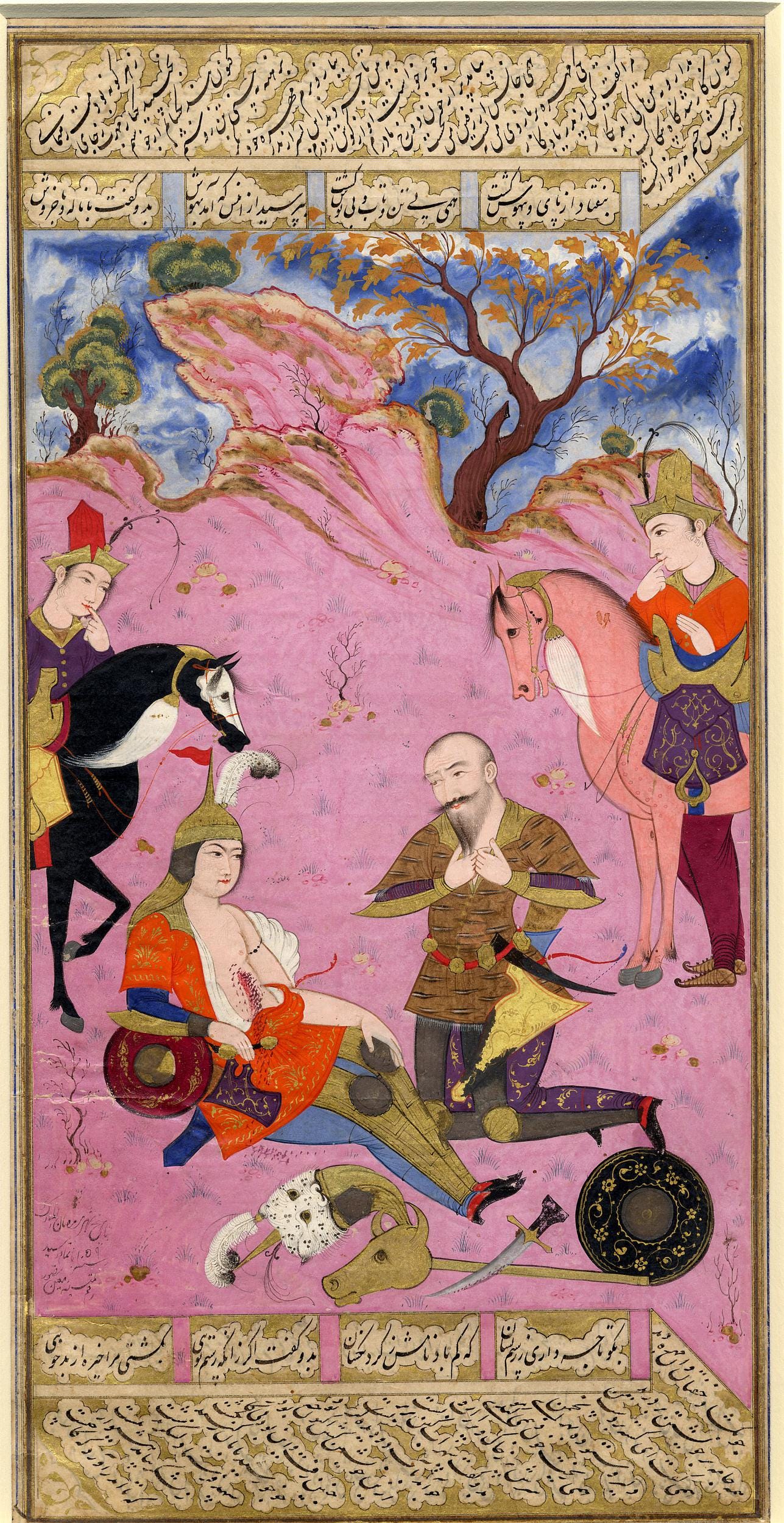
Figure 1. Muʿin Muṣavvir, Rustam and the Dying Suhrab, from the Shāhnāmeh of Firdawsi, Isfahan, 1649.¹¹
From that wound, the later wrestler draws his hardest burden. Power alone may win fear; it does not win reverence. Strength must submit to measure, service, loyalty, and forms of recognition that keep prowess from turning blind. The house of strength grows out of that older pressure, where force passes through chant, witness, hierarchy, and discipline before it meets an opponent.¹² Later language names that burden javanmardi. The name can wait. The burden does not.¹³
II — The house of strength: poem made social
To bear that wound, strength required a house. No one answered blind force by renouncing force. Men lowered it into a chamber, ringed it with witnesses, set a drum above it, and made exertion answer to cadence. The zūrkhāneh gathers that answer in plaster, timber, breath, and rule. One does not stride into such a place. One bows at the low door, then descends. That movement matters. The body passes below the level of the street and enters a space that denies naked prowess. Once lowered into the pit, strength no longer belongs to the solitary man alone. It passes under sequence, supervision, and sound.¹⁴
The room presses the lesson harder. At the center lies the gowd, sunk below the surrounding floor; around it rise seats for spectators, racks for implements, and walls crowded with the faces of champions and saints. Above the floorline stands the sardam, the decorated platform from which command falls. Nothing in that arrangement grants privacy to force. Every swing, lift, bow, and turn enters public view before it courts admiration. Architecture does not merely contain discipline. Architecture delivers the first discipline.¹⁵
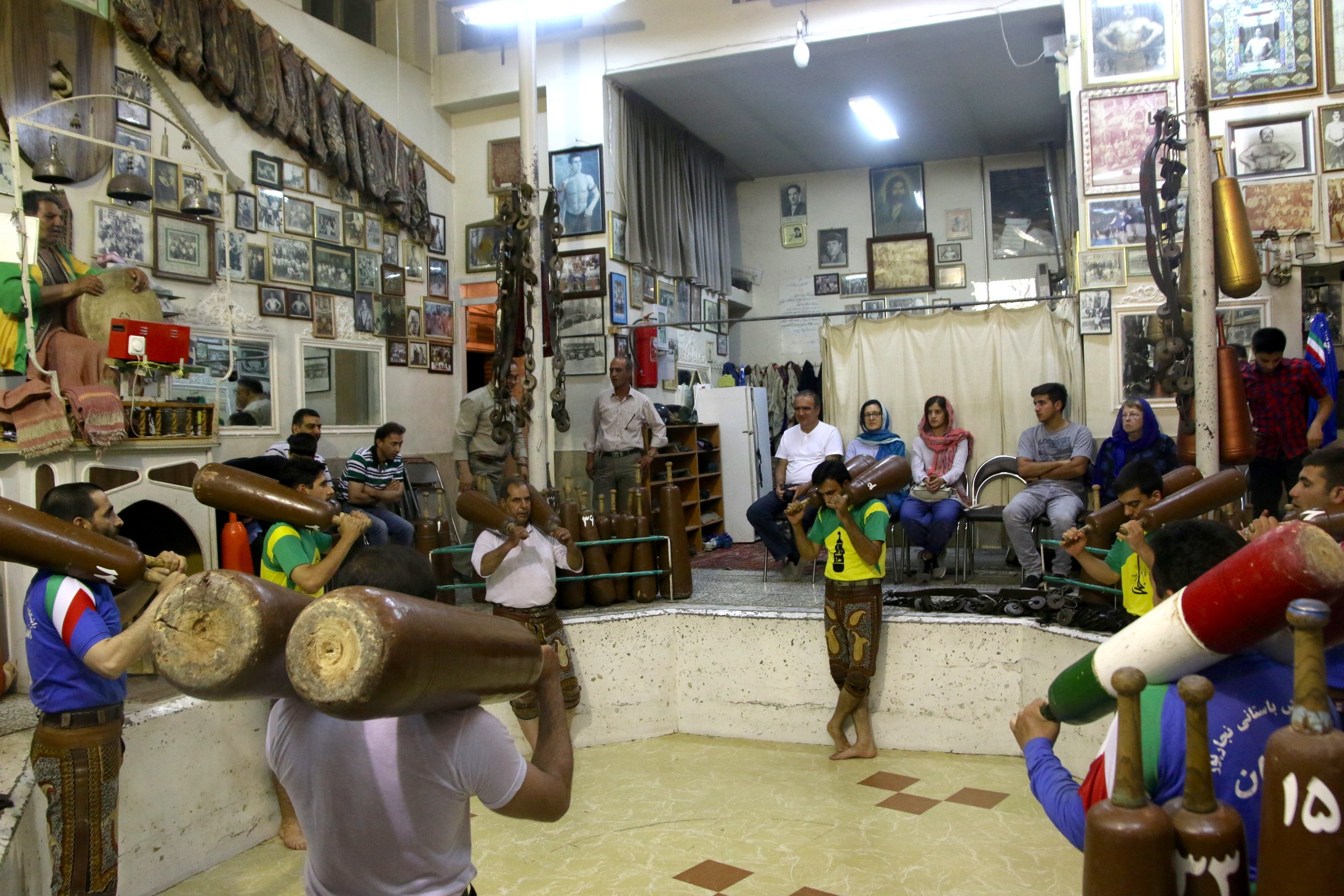
Figure 2. Practice inside a zūrkhāneh in Isfahan: the sunken pit, surrounding witnesses, and elevated drummer place strength under rhythm, order, and public view.¹⁶
Above the pit, the morshed governs more than tempo. He places movement under utterance. The drum strikes measure; epic and mystical verse enter the air; bodies answer with repetition. Breath, sweat, and recitation fold into one act. Under that command, force does not speak its own language. It moves beneath inherited lines, beneath remembered names, beneath a voice that recalls heroes and saints while the clubs rise and fall. What the Shahnameh wounds in text, the room tries to school in practice. The zūrkhāneh rejects mute strength. It insists on strength heard, named, and judged.¹⁷
The athlete learns order before acclaim. He enters through a low door that compels respect. In the gowd he leaves chatter and laughter behind, kisses the ground, and submits his body to a sequence fixed by others. The miāndār leads. Permission must be asked. Men step forward by seniority. Even the exercises school deference: one does not lunge toward display; one waits to be admitted into it. Strength here must take its place before it may show itself.¹⁸
That order presses toward a burden long before it hardens into a title. Later language will call it javanmardi, but conduct carries the code first: give before you boast, protect before you dominate, hold loyalty when vanity would scatter it, bind courage to patience, honesty, and restraint. Older traditions named the virtues in abstract form; the zūrkhāneh gives them muscle, rhythm, and witnesses. Prowess may win fear. It does not win honor unless it carries measure with it.¹⁹
Neither nationalist nostalgia nor clerical simplification can claim the room whole. The zūrkhāneh draws force from overlap: ancient Persian memory, Islamic devotion, initiatory discipline, neighborhood custom, and the ethical afterlife of fotowwa. Poem, piety, hierarchy, and bodily labor enter the same circuit there and keep renewing one another. That layered inheritance gives the institution its thickness. It also gives it durability. A room built from one strand alone might harden into folklore or sermon. This one held because several moral languages met inside it without dissolving into one another.²⁰
From that chamber stepped a figure larger than an athlete. The pahlavān carried rank, yet rank here meant more than victory over an opponent. It marked authority within a community, ethical formation under a champion, and a public expectation that bodily power would protect more than itself. Once strength acquired that moral visibility, it could no longer remain private. The wrestler left the pit bearing not only muscle or fame, but a claim upon the public eye. Sooner or later, one man would carry that claim farther than any other.²¹
III — Takhti: the wrestler leaves the pit
That man had a name: Gholamreza Takhti. Raised in the working-class south of Tehran, far from courtly polish or protected ease, he carried into public life the older burden of the pahlavān. If the Shahnameh had taught Iranian memory how to honor strength, Takhti gave that inheritance a modern body. By the time most Iranians spoke his name with reverence, they no longer meant a mere champion. They meant a man whose force had crossed beyond victory into trust, beyond spectacle into moral weight. In Takhti, strength seemed to answer not only to the mat or the crowd, but to hunger, loss, humiliation, and the stubborn desire that one visible man might still carry himself cleanly before a state no longer trusted to do so.²²
The victories came first, and on a scale large enough to matter. Olympic gold in Melbourne, silver medals on either side of it, world titles, national titles, the rituals of triumph before domestic and international crowds: these gave the country reason to watch. Yet medals alone never explain the hold he kept. Other athletes amassed distinctions. Few turned athletic renown into a moral claim broad enough to survive defeat, aging, and death. Takhti’s body won; his bearing persuaded.²³
That conversion of fame into trust showed itself most clearly not in a stadium but in disaster. After the Boʾin Zahrā earthquake of August 1962, he entered relief work with the kind of force that does not depend on office. Here the old pahlavān ethic shed whatever antiquarian residue still clung to it. The strong man appeared not as ornament of national pride but as courier of aid, collector of donations, mover of bodies and goods toward broken ground. In that moment the public could read him plainly: not simply the man who had defeated foreign opponents, but the man who would not hold himself apart from the wounded poor.²⁴
Politics followed not as a second career but as the consequence of credibility. Takhti’s sympathy for Mohammad Mossadegh—the nationalist prime minister whose name still carried the memory of public dignity—and his collaboration with the revived National Front mattered because they disclosed where his decency leaned when public life hardened into pressure. He did not need to become a professional politician. That would have diminished him. His force lay elsewhere: the wrestler remained legible as wrestler while carrying opposition in full view. When he entered the High Council of the Second National Front in January 1963, sports officialdom could no longer treat him as a harmless national asset.²⁵
Then the rupture came. In January 1968, his body turned up in a room at the Atlantic Hotel. Official media announced suicide. Much of the public rejected the verdict almost at once. The rejection did not arise from evidence alone. It arose from the life already visible behind the death: hardship endured, piety displayed without show, discipline proven over years, and public alignment with the wrong side of power. The state offered one story; Takhti’s life had already taught many Iranians how to hear another. Narrative control began to fray before the body had even reached the grave.²⁶
The funeral gave that fracture its public form. Once the coffin moved, grief no longer belonged to family and intimates alone. It entered procession, rumor, spectacle, and opposition. Mourners carried more than sorrow through the streets; they carried accusation, reverence, and a rehearsal for later political forms. The crowd mattered more than any single slogan. Open protest had narrowed under the Shah. Mourning opened another route. A wrestler’s body, borne toward Ebn Bābuya, drew National Front sympathizers, ordinary admirers, and the politically watchful into one visible assembly. What looked like homage also moved as pressure.²⁷
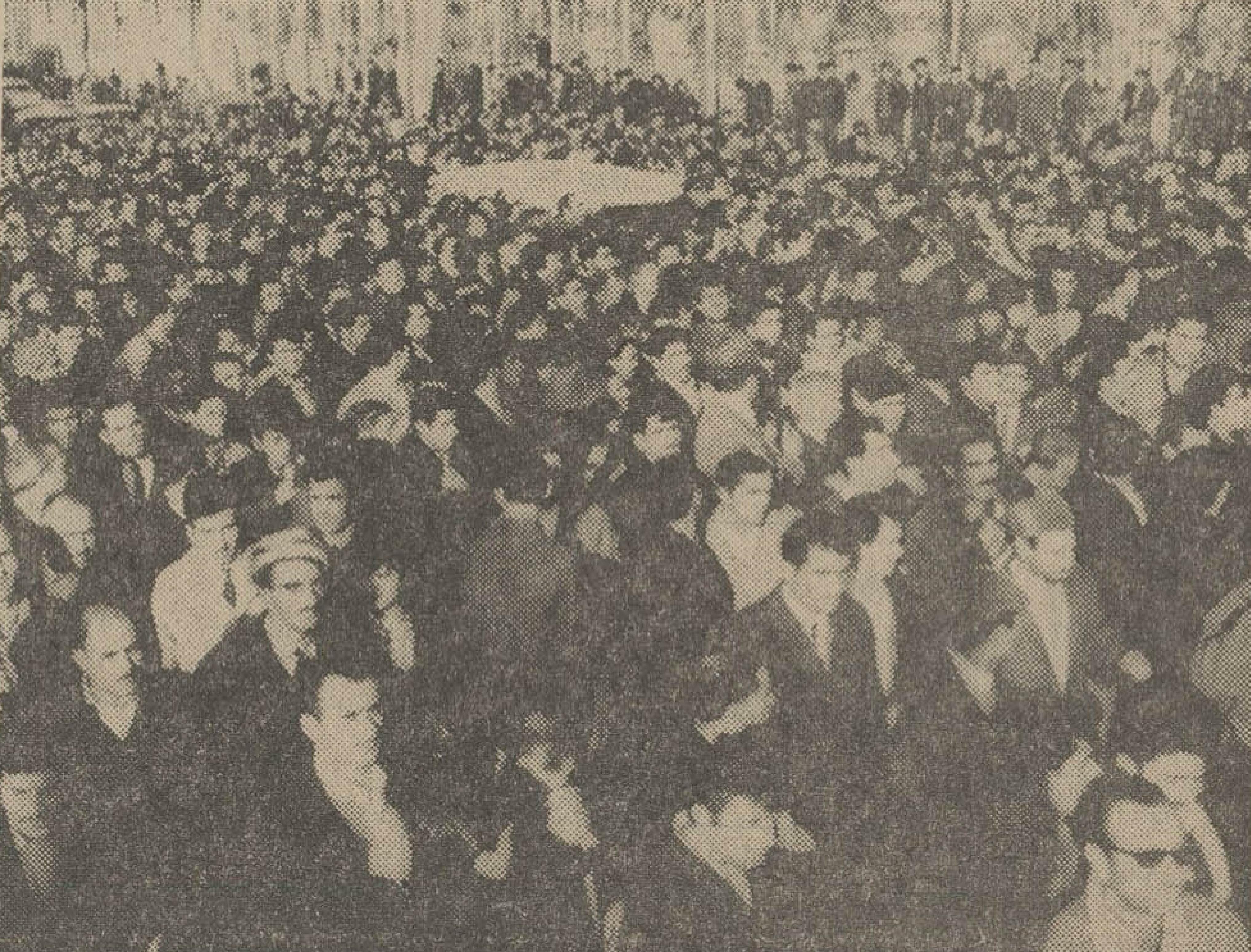
Figure 3. Ettelaʿat, 18 Dey 1346 / 8 January 1968: front-page coverage of Gholamreza Takhti’s funeral.²⁸
Death did not settle Takhti’s meaning. It multiplied it. One memory kept the humble wrestler of the people. Another raised the nationalist patriot. Another held fast to the victim of the Shah. Others, more diffuse but no less persistent, preserved the simple, down-to-earth man whose strength seemed to answer an age afraid of falseness, dependence, and moral thinning. That afterlife explains why he never shrank into sports nostalgia. He remained usable because he remained credible, and he remained credible because humility, plainness, and bodily force had fused in him before any state could fix their meaning in advance.²⁹
From that point forward, wrestling in Iran no longer belonged to sport alone. Takhti had carried the older prestige of the pahlavān into relief work, oppositional politics, and collective mourning; his death showed that the body of a wrestler could still organize public feeling after speech itself had narrowed. Later governments could praise him, borrow his image, and fold his name into official memory. None could do so without entering a field he had already charged.³⁰
IV — 1979 and after: custody without erasure
Takhti had already carried the wrestler beyond sport and into public conscience; after 1979, the question no longer concerned whether wrestling would survive, but under whose moral jurisdiction it would continue. The Islamic Republic did not inherit an empty room. It inherited a chamber already dense with poem, piety, neighborhood prestige, masculine discipline, and a memory the state could neither ignore nor dissolve. It did not abolish that inheritance. It laid claim to it.³¹
The first change came not through destruction but through emphasis. The zūrkhāneh had long drawn authority from overlap: epic memory, Shiʿite symbolism, initiatory hierarchy, and communal ritual. The new order did not bring religion into the room for the first time. It pressed harder on one strand of the room’s legitimacy and made that strand speak louder than the others. What had once moved through mixed inheritance now entered a more explicit official idiom. The house of strength remained standing, but the state began to instruct the house in how it should name itself.³²
That recoding soon reached the level of flesh. Women had never occupied a central place in the classical zūrkhāneh, but after 1979 the state renewed and formalized their exclusion: women were once again barred, boys were permitted into the gowd, and athletes were made to wear tee shirts. None of those measures counts as incidental. Together they rearranged who could appear, who could watch, who could learn, and under what terms the body could present itself. The pit still trained strength, but strength now moved beneath a revised law of visibility—more guarded in one direction, more pedagogically managed in another. Custody ceased to sound theoretical. It became fabric, threshold, and rule.³³
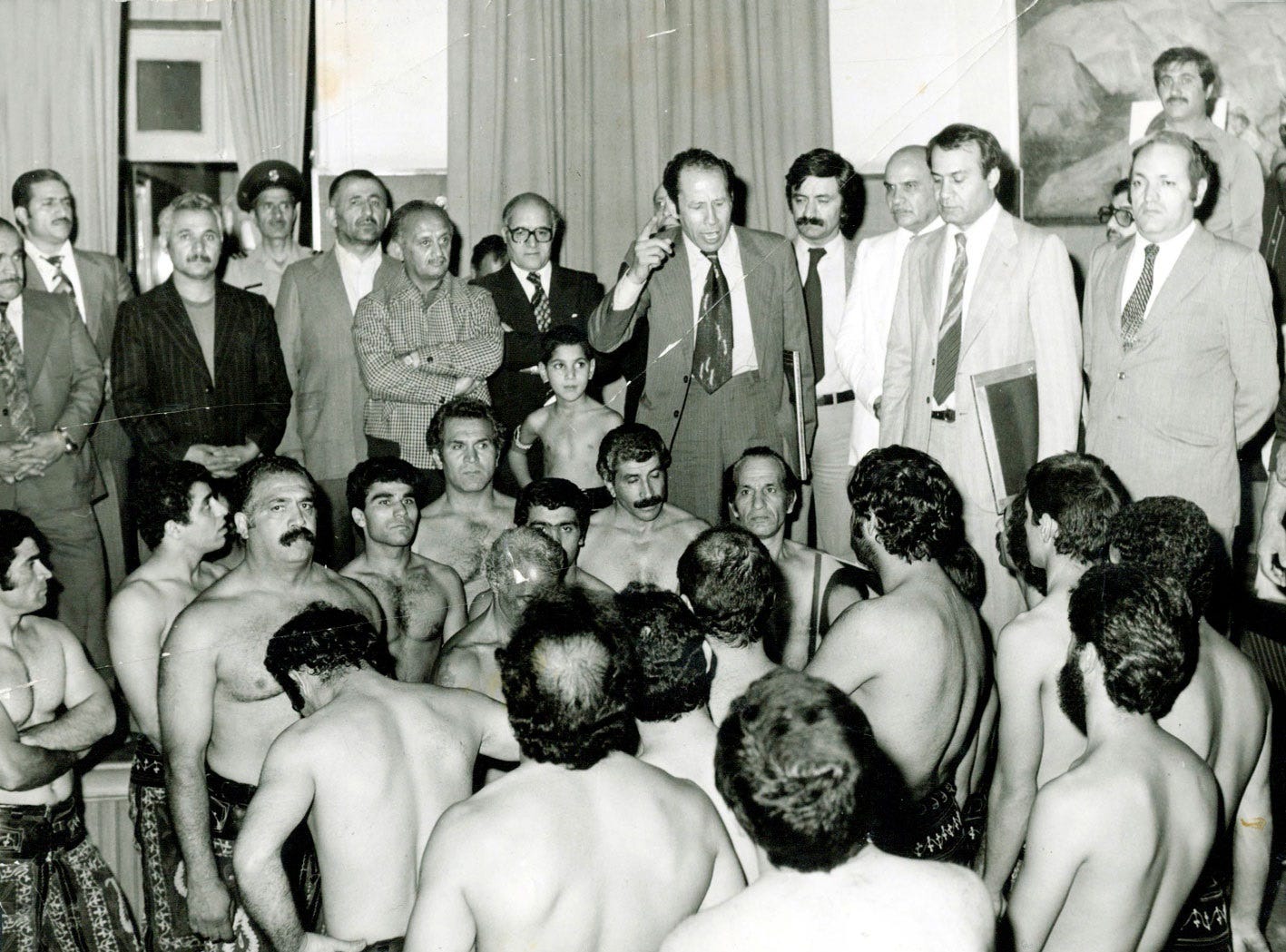
Figure 4. Sadegh Ghotbzadeh visits a zūrkhāneh in Tehran, 1979. The photograph shows the revolutionary state entering an inherited masculine institution it did not create but would soon seek to guide, regulate, and publicly claim.³⁴
That same process did not stop at visibility. The regime did not merely moralize the old institution. It bureaucratized it. Competitions proliferated. Exercises that had once drawn authority from local rhythm, inherited sequence, and self-regulating custom came under increasing pressure to resemble modern sport, complete with point systems, records, and champions. That shift matters because it breaks the false contrast between Islamization and modernization. The Islamic Republic pursued both at once. It narrowed autonomy while widening administration, and older athletes resented the intrusion of an official body into a sphere that had long governed itself.³⁵
Yet the state did not lower wrestling’s prestige. It retained and displayed it at the summit. A regime that truly found the institution alien or disposable would have let it wither. Instead, it preserved the room, celebrated the champions, and continued to draw upon the older moral language of wrestling because the tradition still carried symbolic force too dense to discard. Preservation and supervision advanced together.³⁶
Takhti returned under those conditions, but not unchanged. The Islamic Republic could not erase him; his name had already entered the country’s moral memory too deeply. It therefore reframed him. A man who had stood with Moṣaddeq and the National Front could now reappear inside a more usable official narrative, his piety foregrounded, his politics selectively absorbed, his death folded into a story the new order could live with. That act did not settle his meaning. It merely proved that the state had entered the contest over him and intended to administer memory as well as ritual.³⁷
So wrestling survived the revolution, but not on its own terms. The room remained. The drum remained. The champions remained. But visibility narrowed, autonomy thinned, and the institution’s mixed inheritance passed under ideological and bureaucratic supervision. The Islamic Republic did not destroy the old prestige of wrestling because it needed that prestige too badly. It took custody of it instead, and in doing so prepared the next narrowing: from the institution under supervision to the wrestler under watch.³⁸
V — The wrestler under custody
The wrestler now enters under terms he did not choose. The low door still bends the spine. The drum still governs tempo. The morshed still holds the air. Yet the body no longer offers itself to the zūrkhāneh as inherited strength alone. It arrives already interpreted: a male form moving inside a space whose moral terms have been fixed in advance. What older discipline once bound to chant, witness, and communal rank now passes through a narrower corridor of authorized appearance.³⁹
That settlement declares itself first to the eye. Before a wrestler lifts a club or turns inside the pit, the question of how the body may appear has already been answered for him. Cloth, spectatorship, and access no longer drift by custom alone. They harden into visible order. The torso still carries prestige, but not on its own terms. It appears as a body rendered permissible, supervised, and fit for a revised moral gaze. Boys descend into the gowd under those same terms, learning from the beginning that strength does not merely train; it appears correctly.⁴⁰
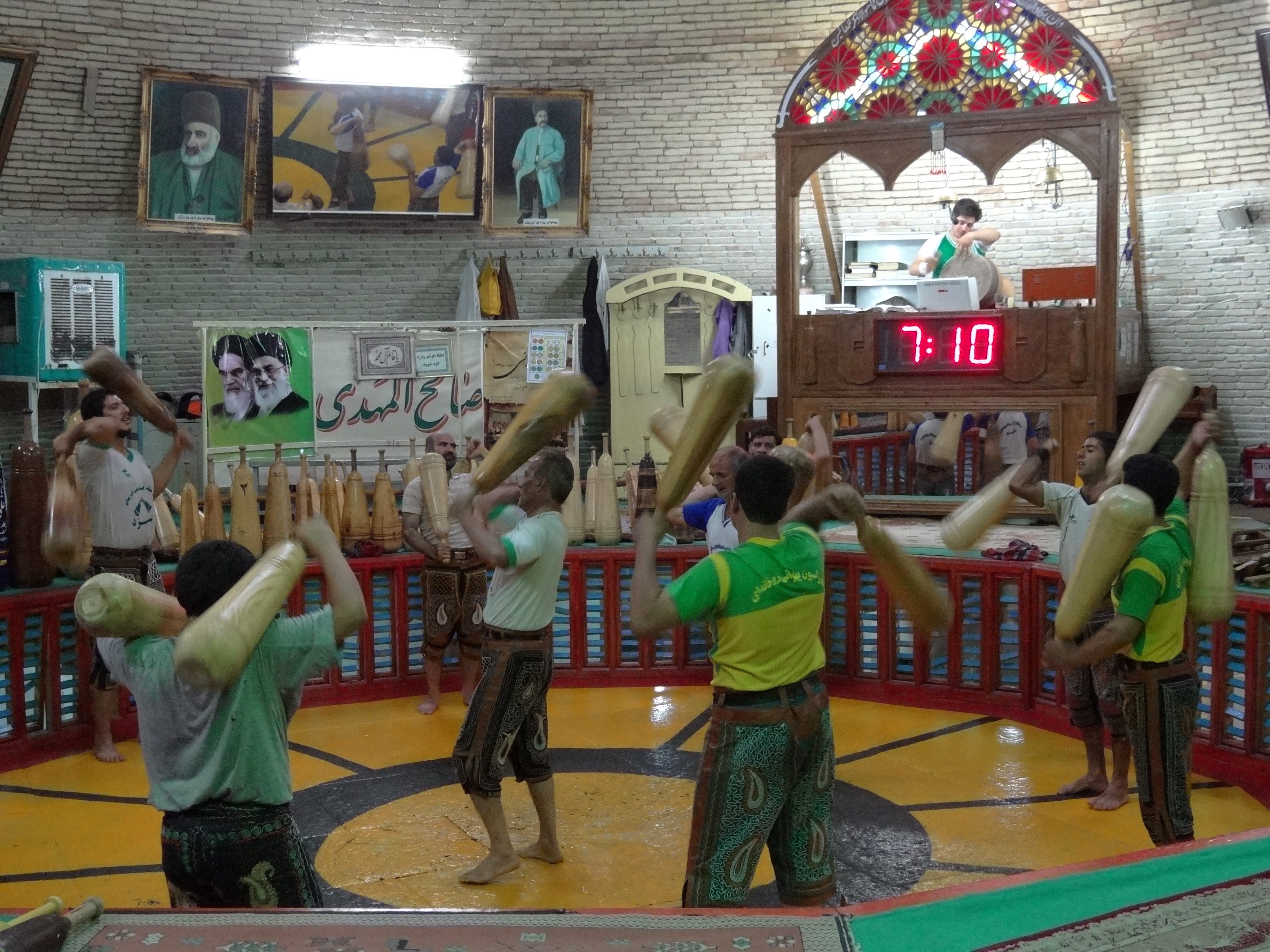
Figure 5. Training in a zūrkhāneh in Yazd, 2012. Ordinary practice rather than ceremonial spectacle: clothed wrestlers move under ordered scrutiny, the disciplined male body appearing not as spontaneous force but as supervised habit.⁴¹
That early formation matters because custody reaches forward into the making of wrestlers themselves. The state does not merely inherit finished athletes and place them on display. It enters the reproduction of the type. The young body now descends into a pit that still looks old but no longer transmits itself on old terms alone. Hierarchy remains. Repetition remains. But discipline now schools the athlete twice over: once in the inherited ethic of the house, and once in the authorized ways a body should carry that ethic before others.⁴²
From inside the room, bureaucratic change does not feel abstract. The clubs still rise and fall in familiar arcs, yet the wrestler trains more and more inside a language of standardization: rules, rankings, competitions, champions, records, oversight. What once leaned on local sequence and civic habit now bends toward uniform performance. Older athletes feel the change most sharply because it touches not a surface custom but the room’s former power to regulate itself. The body still trains under tradition; it now does so inside an administrative grid.⁴³
Once that body leaves the pit, another layer of custody takes hold. The wrestler appears in photographs, ceremonies, federation prose, and official messages as something more than an athlete. He carries representation. Victory no longer signifies only personal excellence or neighborhood honor. It signifies national joy, national dignity, national proof. The wrestler thus becomes a public surface on which the state can display discipline, sacrifice, and legitimacy without surrendering control of the script.⁴⁴
Praise completes the mechanism. The supervised body does not live by restriction alone; it lives by moral elevation. Official language fastens dignity, self-sacrifice, honor, and restraint to the wrestler’s public image, teaching admiration to move along authorized lines. A champion receives more than congratulations. He receives a role. The body counts not only because it wins, but because it can be read as carrying the proper inner discipline in visible form.⁴⁵
So the wrestler remains honored, but not freely so. Prestige survives. Fame survives. Even the old charge of the pahlavān survives. Yet the body that bears those honors moves within a narrower corridor of appearance, meaning, and approval than before. It still draws reverence, but that reverence now passes more fully through supervision. The result is not abolition but exposure. Once the body has been taught how to appear correctly, the distance between honor and danger shortens the moment it ceases to speak the language laid over it.⁴⁶
VI — The honored wrestler and the disposable wrestler
State honor did not guarantee the wrestler’s life. The Islamic Republic kept the wrestler as emblem, praised him as bearer of dignity and national pride, and still reserved the power to recast the same body as criminal, traitor, or expendable matter the moment it entered the wrong political script. The contradiction no longer lived in symbolism alone. It reached the gallows.⁴⁷
Navid Afkari remains the clearest documented fracture. He had been a wrestler; he also took part in the protests of 2018. The judiciary convicted him of murdering a security employee, while Afkari, his family, and rights groups said the case rested on torture and forced confession. Human Rights Watch called his case part of a “systematic pattern” in which Iranian authorities disregard torture allegations and use coerced confessions in trial proceedings. Amnesty said the state executed him secretly on September 12, 2020, without prior notice to him, his family, or his lawyer, after what it described as a grossly unfair trial.⁴⁸
In such cases, the wrestler’s body does not lose its symbolic charge. It changes register. The body once praised for discipline, restraint, and public worth becomes prosecutable matter. The body once honored as example can be rewritten as evidence against itself, then disappear beneath a verdict the state calls justice.⁴⁹
Saleh Mohammadi shows the same contradiction in a younger and harsher form. Reuters reported in March 2026 that Mohammadi, a nineteen-year-old wrestler, was among three men executed for their alleged role in the January protests and the killing of two police officers. Amnesty had already warned in February 2026 that Iranian authorities were fast-tracking grossly unfair capital cases tied to those protests, including cases involving torture allegations. Here the pattern no longer looked exceptional. It looked renewed.⁵⁰
Death did not end custody. In Afkari’s case, the state moved in secrecy, denying him and his family prior notice. In the March 2026 executions, the state moved in spectacle: state media circulated courtroom imagery after the hangings, and the state’s narrative of guilt followed the condemned bodies to the end. One death arrived behind closed doors, the other before a managed audience, but both remained under the same sovereign claim over confession, sentence, and final meaning.⁵¹
The wrestler still receives praise, and wrestling still carries honor. Official language continues to fasten dignity, sacrifice, and national pride to the wrestler’s public image. Yet belonging to that honored class does not protect the unauthorized person. The system preserves the prestige of wrestling while discarding particular wrestlers when their bodies enter politics outside the script laid over them. The drum still sounds. The room still stands. Yet its prestige now falls under a shadow it cannot lift: the same state that crowns the wrestler as symbol can also reduce him to confession, sentence, rope, and official explanation.⁵²
Coda — The poem still sounding
The low door still bends the spine. The morshed still strikes the drum. Clubs still rise and fall above the gowd in measured arcs, and the old verses still pass through breath into labor. The room has not vanished. The ritual has not gone silent. But the rhythm no longer reaches the ear as mere continuity. Too much has passed through it. Too many bodies have carried its burden into a harsher age.⁵³
Figure 6. POWER Workout • Zurkhaneh Ritual • Tehran • IRAN زور خانه. The pattern endures: drum, pit, rotation, strain.⁵⁴
Honor still rises from the room toward the nation. Champions still receive praise. Official language still fastens dignity, sacrifice, and pride to the wrestler’s figure, drawing on an older moral charge it cannot afford to discard. The wrestler still signifies more than victory. He still bears virtue in public form.⁵⁵
Yet the room now sounds under heavier names. Takhti remains in it. Afkari remains in it. Mohammadi remains in it. They do not break the inheritance; they alter its resonance. The zūrkhāneh still keeps faith with poem, strain, and disciplined force, but it no longer keeps them free of custody, recoding, and loss. The house of strength endures. It endures under pressure. The poem still sounds, but it no longer sounds innocent.
Endnotes
UNESCO, “The Pahlevani and Zoorkhanei Rituals,” Intangible Heritage, accessed March 31, 2026, https://ich.unesco.org/en/RL/pahlevani-and-zoorkhanei-rituals-00378; Houchang E. Chehabi, “Zur-Ḵāna,” in Encyclopaedia Iranica, updated August 6, 2015, https://www.iranicaonline.org/articles/zur-kana.
UNESCO, “Pahlevani and Zoorkhanei Rituals.”
Mohsen Zakeri, “Javānmardi,” in Encyclopaedia Iranica, accessed March 31, 2026, https://www.iranicaonline.org/articles/javanmardi; UNESCO, “Pahlevani and Zoorkhanei Rituals.”
Chehabi, “Zur-Ḵāna”; Zakeri, “Javānmardi.”
Abolqasem Ferdowsi, Shahnameh: The Persian Book of Kings, trans. Dick Davis (New York: Penguin Books, 2016), “Rostam and Sohrab”; “Šāh-nāma,” in Encyclopaedia Iranica, accessed March 31, 2026, https://www.iranicaonline.org/articles/sah-nama.
Amin Banani, “Šāh-Nāma V. Excursus,” in Encyclopaedia Iranica, accessed March 31, 2026, https://www.iranicaonline.org/articles/shahnameh/v-excursus.
Ferdowsi, Shahnameh, “Rostam and Sohrab.”
Banani, “Šāh-Nāma V. Excursus.”
Ferdowsi, Shahnameh, “Rostam and Sohrab.”
Ferdowsi, Shahnameh, “Rostam and Sohrab.”
Muʿin Muṣavvir, Rustam and the Dying Suhrab, from the Shāhnāmeh of Firdawsi, Isfahan, 1649, ink, opaque watercolor, and gold on paper, British Museum, museum no. 1922,0711,0.2, https://www.britishmuseum.org/collection/object/W_1922-0711-0-2.
UNESCO, “Pahlevani and Zoorkhanei Rituals.”
Zakeri, “Javānmardi.”
Chehabi, “Zur-Ḵāna”; UNESCO, “Pahlevani and Zoorkhanei Rituals.”
Chehabi, “Zur-Ḵāna”; UNESCO, “Pahlevani and Zoorkhanei Rituals.”
Tu Manling, Regular Practice of Zurkhaneh in Isfahan, photograph, May 27, 2016, Wikimedia Commons, CC BY-SA 4.0, https://commons.wikimedia.org/wiki/File:Regular_Practice_of_Zurkhaneh_in_Isfahan.jpg.
UNESCO, “Pahlevani and Zoorkhanei Rituals”; Chehabi, “Zur-Ḵāna.”
Chehabi, “Zur-Ḵāna.”
Zakeri, “Javānmardi”; UNESCO, “Pahlevani and Zoorkhanei Rituals.”
UNESCO, “Pahlevani and Zoorkhanei Rituals”; Chehabi, “Zur-Ḵāna”; Zakeri, “Javānmardi.”
UNESCO, “Pahlevani and Zoorkhanei Rituals.”
Houchang E. Chehabi, “Taḵti, Ḡolām-Reżā,” in Encyclopaedia Iranica, published July 20, 2005, https://www.iranicaonline.org/articles/takti-golam-reza; Olmo Gölz, “The Wrestler’s Strength and Humility: On Gholamreza Takhti, Masculinity, and the Search for Authenticity in a ‘West-Infested’ Iran,” Zeithistorische Forschungen/Studies in Contemporary History 18, no. 3 (2021): 453–82, https://doi.org/10.14765/zzf.dok-2465.
Chehabi, “Taḵti, Ḡolām-Reżā.”
Chehabi, “Taḵti, Ḡolām-Reżā.”
Chehabi, “Taḵti, Ḡolām-Reżā”; Gölz, “Wrestler’s Strength and Humility.”
Arash Davari and Naghmeh Sohrabi, “A Sky Drowning in Stars: Global ’68, the Death of Takhti, and the Birth of the Iranian Revolution,” in Global 1979: Geographies and Histories of the Iranian Revolution, ed. Arang Keshavarzian and Ali Mirsepassi (Cambridge: Cambridge University Press, 2021), 213–43; Chehabi, “Taḵti, Ḡolām-Reżā.”
Chehabi, “Taḵti, Ḡolām-Reżā”; Davari and Sohrabi, “Sky Drowning in Stars.”
Ettelaʿat (Tehran), 18 Dey 1346 / January 8, 1968, front page, reproduced via Wikimedia Commons, public domain in Iran, https://commons.wikimedia.org/wiki/File:%D8%AA%D8%B4%DB%8C%DB%8C%D8%B9_%D8%AC%D9%86%D8%A7%D8%B2%D9%87_%D8%BA%D9%84%D8%A7%D9%85%D8%B1%D8%B6%D8%A7_%D8%AA%D8%AE%D8%AA%DB%8C_-_%D8%B1%D9%88%D8%B2%D9%86%D8%A7%D9%85%D9%87_%D8%A7%D8%B7%D9%84%D8%A7%D8%B9%D8%A7%D8%AA%D8%8C_%DB%B1%DB%B8_%D8%AF%DB%8C_%DB%B1%DB%B3%DB%B4%DB%B6%D8%8C_%D8%B5%D9%81%D8%AD%D9%87_%DB%B1.jpg.
Gölz, “Wrestler’s Strength and Humility”; Chehabi, “Taḵti, Ḡolām-Reżā.”
Chehabi, “Taḵti, Ḡolām-Reżā.”
Chehabi, “Zur-Ḵāna”; UNESCO, “Pahlevani and Zoorkhanei Rituals.”
Chehabi, “Zur-Ḵāna.”
Chehabi, “Zur-Ḵāna.”
Sadegh Ghotbzadeh Visits a Zoorkhaneh of Tehran, 1979, photograph, Wikimedia Commons, https://commons.wikimedia.org/wiki/File:Sadegh_Ghotbzadeh_visits_a_zoorkhaneh_of_Tehran,_1979.jpg.
Chehabi, “Zur-Ḵāna.”
“Leader’s Message of Congratulations to the Greco-Roman Wrestling Champions,” Khamenei.ir, September 21, 2025, https://english.khamenei.ir/news/11911/Leader-s-message-of-congratulations-to-the-Greco-Roman-wrestling; “I Thank Alireza Karimi Who Became a Symbol of Dignity for the Iranian People,” Khamenei.ir, December 6, 2017, https://english.khamenei.ir/news/5323/I-thank-Alireza-Karimi-who-became-a-symbol-of-dignity-for-the.
Chehabi, “Taḵti, Ḡolām-Reżā.”
Chehabi, “Zur-Ḵāna”; Khamenei.ir, “Leader’s Message of Congratulations to the Greco-Roman Wrestling Champions.”
H. E. Chehabi, “Gender Anxieties in the Iranian Zūrkhānah,” International Journal of Middle East Studies 51, no. 3 (2019): 395–421, https://doi.org/10.1017/S0020743819000404; Chehabi, “Zur-Ḵāna.”
Chehabi, “Gender Anxieties in the Iranian Zūrkhānah”; Chehabi, “Zur-Ḵāna.”
Adam Jones, Men Working Out at Zurkhaneh (House of Strength) – Yazd – Central Iran, photograph, June 21, 2012, Wikimedia Commons, CC BY-SA 2.0, https://commons.wikimedia.org/wiki/File:Men_Working_Out_at_Zurkhaneh_%28House_of_Strength%29_-_Yazd_-_Central_Iran.jpg.
Chehabi, “Zur-Ḵāna.”
Philippe Rochard, “The Identities of the Iranian Zūrkhanah,” Iranian Studies 35, no. 4 (2002): 313–40; Chehabi, “Zur-Ḵāna.”
Khamenei.ir, “Leader’s Message of Congratulations to the Greco-Roman Wrestling Champions.”
Khamenei.ir, “I Thank Alireza Karimi Who Became a Symbol of Dignity for the Iranian People.”
Chehabi, “Zur-Ḵāna”; Khamenei.ir, “Leader’s Message of Congratulations to the Greco-Roman Wrestling Champions”; Khamenei.ir, “I Thank Alireza Karimi Who Became a Symbol of Dignity for the Iranian People.”
Khamenei.ir, “I Thank Alireza Karimi Who Became a Symbol of Dignity for the Iranian People”; Human Rights Watch, “Iran Suddenly Executes Wrestler Navid Afkari,” September 12, 2020, https://www.hrw.org/news/2020/09/12/iran-suddenly-executes-wrestler-navid-afkari.
Human Rights Watch, “Iran Suddenly Executes Wrestler Navid Afkari”; Amnesty International, “Iran: Secret Execution of Wrestler Navid Afkari a ‘Travesty of Justice’,” September 12, 2020, https://www.amnesty.org/en/latest/news/2020/09/iran-secret-execution-of-wrestler-navid-afkari-a-travesty-of-justice-2/; Reuters, “Iranian Wrestler Navid Afkari Executed over 2018 Security Guard Killing,” September 12, 2020, https://www.reuters.com/business/media-telecom/iranian-wrestler-navid-afkari-executed-over-2018-security-guard-killing-2020-09-12/.
Human Rights Watch, “Iran Suddenly Executes Wrestler Navid Afkari.”
Reuters, “Iran Executes Three Individuals Arrested over January Protests, State Media,” March 19, 2026, https://www.reuters.com/world/middle-east/iran-executes-three-individuals-arrested-over-january-protests-state-media-2026-03-19/; Reuters, “Former Iranian Water Polo Player Soleimani Distraught over Wrestler’s Execution,” March 20, 2026, https://www.reuters.com/world/former-iranian-water-polo-player-soleimani-distraught-over-wrestlers-execution-2026-03-20/; Amnesty International, “Iran: Children among 30 People at Risk of the Death Penalty amid Expedited Grossly Unfair Trials Connected to Uprising,” February 20, 2026, https://www.amnesty.org/en/latest/news/2026/02/iran-children-among-30-people-at-risk-of-the-death-penalty-amid-expedited-grossly-unfair-trials-connected-to-uprising/.
Amnesty International, “Iran: Secret execution of wrestler Navid Afkari a ‘travesty of justice’,” September 12, 2020; Reuters Connect, “REFILE: Iranian state media release video from courtroom after three people executed over January protests,” March 19, 2026.
Khamenei.ir, “I Thank Alireza Karimi Who Became a Symbol of Dignity for the Iranian People”; Human Rights Watch, “Iran Suddenly Executes Wrestler Navid Afkari”; Reuters, “Former Iranian Water Polo Player Soleimani Distraught over Wrestler’s Execution.”
UNESCO, “Pahlevani and Zoorkhanei Rituals.”
“POWER Workout • Zurkhaneh Ritual • Tehran • IRAN زور خانه,” YouTube video, accessed March 31, 2026.
Khamenei.ir, “I Thank Alireza Karimi Who Became a Symbol of Dignity for the Iranian People.”


Bibliography
Amnesty International. “Iran: Children among 30 People at Risk of the Death Penalty amid Expedited Grossly Unfair Trials Connected to Uprising.” February 20, 2026. https://www.amnesty.org/en/latest/news/2026/02/iran-children-among-30-people-at-risk-of-the-death-penalty-amid-expedited-grossly-unfair-trials-connected-to-uprising/.
———. “Iran: Secret Execution of Wrestler Navid Afkari a ‘Travesty of Justice.’” September 12, 2020. https://www.amnesty.org/en/latest/news/2020/09/iran-secret-execution-of-wrestler-navid-afkari-a-travesty-of-justice-2/.
Banani, Amin. “Šāh-Nāma V. Excursus.” Encyclopaedia Iranica. Accessed March 31, 2026. https://www.iranicaonline.org/articles/shahnameh/v-excursus.
Chehabi, H. E. “Gender Anxieties in the Iranian Zūrkhānah.” International Journal of Middle East Studies 51, no. 3 (2019): 395–421. https://doi.org/10.1017/S0020743819000404.
Chehabi, Houchang E. “Taḵti, Ḡolām-Reżā.” Encyclopaedia Iranica. Published July 20, 2005. https://www.iranicaonline.org/articles/takti-golam-reza.
———. “Zur-Ḵāna.” Encyclopaedia Iranica. Updated August 6, 2015. https://www.iranicaonline.org/articles/zur-kana.
Davari, Arash, and Naghmeh Sohrabi. “A Sky Drowning in Stars: Global ’68, the Death of Takhti, and the Birth of the Iranian Revolution.” In Global 1979: Geographies and Histories of the Iranian Revolution, edited by Arang Keshavarzian and Ali Mirsepassi, 213–43. Cambridge: Cambridge University Press, 2021.
Ettelaʿat (Tehran). January 8, 1968. Front page. Reproduced via Wikimedia Commons. https://commons.wikimedia.org/wiki/File:%D8%AA%D8%B4%DB%8C%DB%8C%D8%B9_%D8%AC%D9%86%D8%A7%D8%B2%D9%87_%D8%BA%D9%84%D8%A7%D9%85%D8%B1%D8%B6%D8%A7_%D8%AA%D8%AE%D8%AA%DB%8C_-_%D8%B1%D9%88%D8%B2%D9%86%D8%A7%D9%85%D9%87_%D8%A7%D8%B7%D9%84%D8%A7%D8%B9%D8%A7%D8%AA%D8%8C_%DB%B1%DB%B8_%D8%AF%DB%8C_%DB%B1%DB%B3%DB%B4%DB%B6%D8%8C_%D8%B5%D9%81%D8%AD%D9%87_%DB%B1.jpg.
Ferdowsi, Abolqasem. Shahnameh: The Persian Book of Kings. Translated by Dick Davis. New York: Penguin Books, 2016.
Gölz, Olmo. “The Wrestler’s Strength and Humility: On Gholamreza Takhti, Masculinity, and the Search for Authenticity in a ‘West-Infested’ Iran.” Zeithistorische Forschungen/Studies in Contemporary History 18, no. 3 (2021): 453–82. https://doi.org/10.14765/zzf.dok-2465.
Human Rights Watch. “Iran Suddenly Executes Wrestler Navid Afkari.” September 12, 2020. https://www.hrw.org/news/2020/09/12/iran-suddenly-executes-wrestler-navid-afkari.
Jones, Adam. Men Working Out at Zurkhaneh (House of Strength) – Yazd – Central Iran. Photograph. June 21, 2012. Wikimedia Commons. https://commons.wikimedia.org/wiki/File:Men_Working_Out_at_Zurkhaneh_%28House_of_Strength%29_-_Yazd_-_Central_Iran.jpg.
Khamenei.ir. “I Thank Alireza Karimi Who Became a Symbol of Dignity for the Iranian People.” December 6, 2017. https://english.khamenei.ir/news/5323/I-thank-Alireza-Karimi-who-became-a-symbol-of-dignity-for-the.
———. “Leader’s Message of Congratulations to the Greco-Roman Wrestling Champions.” September 21, 2025. https://english.khamenei.ir/news/11911/Leader-s-message-of-congratulations-to-the-Greco-Roman-wrestling.
Manling, Tu. Regular Practice of Zurkhaneh in Isfahan. Photograph. May 27, 2016. Wikimedia Commons. https://commons.wikimedia.org/wiki/File:Regular_Practice_of_Zurkhaneh_in_Isfahan.jpg.
Muṣavvir, Muʿin. Rustam and the Dying Suhrab. From the Shāhnāmeh of Firdawsi. Isfahan, 1649. Ink, opaque watercolor, and gold on paper. British Museum, 1922,0711,0.2. https://www.britishmuseum.org/collection/object/W_1922-0711-0-2.
“POWER Workout • Zurkhaneh Ritual • Tehran • IRAN زور خانه.” YouTube video. Accessed March 31, 2026.
Reuters. “Former Iranian Water Polo Player Soleimani Distraught over Wrestler’s Execution.” March 20, 2026. https://www.reuters.com/world/former-iranian-water-polo-player-soleimani-distraught-over-wrestlers-execution-2026-03-20/.
———. “Iran Executes Three Individuals Arrested over January Protests, State Media.” March 19, 2026. https://www.reuters.com/world/middle-east/iran-executes-three-individuals-arrested-over-january-protests-state-media-2026-03-19/.
———. “Iranian Wrestler Navid Afkari Executed over 2018 Security Guard Killing.” September 12, 2020. https://www.reuters.com/business/media-telecom/iranian-wrestler-navid-afkari-executed-over-2018-security-guard-killing-2020-09-12/.
Reuters Connect. “REFILE: Iranian State Media Release Video from Courtroom after Three People Executed over January Protests.” March 19, 2026.
Rochard, Philippe. “The Identities of the Iranian Zūrkhanah.” Iranian Studies 35, no. 4 (2002): 313–40.
“Sadegh Ghotbzadeh Visits a Zoorkhaneh of Tehran, 1979.” Photograph. Wikimedia Commons. https://commons.wikimedia.org/wiki/File:Sadegh_Ghotbzadeh_visits_a_zoorkhaneh_of_Tehran,_1979.jpg.
“Šāh-nāma.” Encyclopaedia Iranica. Accessed March 31, 2026. https://www.iranicaonline.org/articles/sah-nama.
UNESCO. “The Pahlevani and Zoorkhanei Rituals.” Intangible Heritage. Accessed March 31, 2026. https://ich.unesco.org/en/RL/pahlevani-and-zoorkhanei-rituals-00378.
Zakeri, Mohsen. “Javānmardi.” Encyclopaedia Iranica. Accessed March 31, 2026. https://www.iranicaonline.org/articles/javanmardi.